Trekking pole selection significantly impacts hiking comfort and performance. Cork handles offer distinct advantages over rubber or foam alternatives, molding to individual grip patterns while managing dampness effectively. Yet choosing the right pair extends beyond material—pole length, adjustability, shock absorption, and construction materials all influence your trail experience. Understanding these factors determines whether your investment improves or hinders your next expedition.


Key Takeaways
- Cork handles mold to hand shapes, reduce blisters, absorb sweat, and provide superior comfort during extended trail use.
- Calculate ideal pole length using height × 0.68 for moderate hiking or × 0.72 for vigorous activities.
- Choose adjustable poles for variable terrain with quick length changes; select fixed poles for consistent routes with better stability.
- Carbon poles weigh less but are brittle; aluminum poles are heavier but more durable and easily repairable.
- Match poles to your hiking style by considering terrain type, distance, weather conditions, and personal biomechanical needs.
Why Cork Handles Outperform Other Grip Materials?
When selecting trekking poles, the grip material significantly impacts both performance and comfort during extended use. Cork handles deliver superior cork benefits compared to foam or rubber alternatives. The natural material molds to individual hand shapes, enhancing grip comfort while reducing blister risk on demanding trails.
Cork’s exceptional humidity resistance absorbs sweat without sacrificing control, vital during warm-weather hiking. Its lightweight yet durable composition provides excellent vibration absorption, minimizing wrist and arm fatigue on uneven terrain where other materials fail to perform adequately.
For environmentally conscious hikers, cork represents a renewable resource harvested sustainably from cork oak trees. This combination of technical performance and ecological responsibility makes cork-handle trekking poles the best choice for serious trekkers seeking reliable, sustainable gear.
Determine Your Ideal Pole Length
Calculating the correct pole length begins with a straightforward formula: multiply your height in centimeters by 0.68, then verify the fit by ensuring your elbows bend at 90 degrees when standing with poles on flat ground. Terrain demands flexibility in pole length; shorten poles by 5-10 cm when ascending steep grades to reduce shoulder strain, and lengthen them by the same amount on descents to improve stability and control. Regular adjustments before and during hikes maintain proper arm positioning and prevent fatigue that accumulates from poorly fitted poles.
Height-to-Pole Ratio
Proper sizing forms the foundation of effective trekking pole use. A straightforward formula determines ideal pole length: multiply height in centimeters by 0.68 for moderate hiking or 0.72 for vigorous activities. A 170 cm hiker, for instance, requires approximately 115 cm poles for leisurely treks or 122 cm for strenuous climbs.
The 90-degree elbow angle serves as the primary verification method. When standing on flat terrain with the pole tip touching ground, the elbow should form this precise angle, ensuring suitable comfort and biomechanical support.
Terrain demands height adjustments beyond the base calculation. Shorten poles by 5-10 cm for uphill climbs to reduce strain. Conversely, lengthen them by the same amount for downhill descents to maintain stability. Consulting brand-specific sizing charts before purchasing further refines pole selection and guarantees proper fit.
Terrain-Based Length Selection
While the baseline formula and 90-degree angle test establish a starting point, topography variations demand real-world adjustments that significantly impact performance and comfort.
Uphill terrain conditions require shortening poles by 5-10 cm to maintain stability during ascents and reduce shoulder strain. This adjustment preserves proper posture when climbing steep grades.
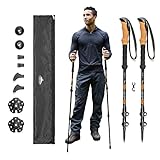
Conversely, downhill hiking demands lengthening poles by 5-10 cm to absorb impact shock and protect knees from excessive stress. Extended poles improve balance control on descents where stability becomes critical.
These pole adjustments represent crucial modifications beyond initial sizing. Hikers who adapt their equipment to specific terrain conditions experience noticeably improved efficiency and reduced fatigue. The freedom to adjust poles between terrain types—rather than committing to fixed lengths—empowers trekkers to optimize their experience across diverse environments and challenging conditions throughout their journey.
Adjustable vs. Fixed Cork Poles: Which Fits Your Needs
Adjustable poles excel on variable terrain where gradient changes demand quick length modifications, while fixed poles maintain consistent performance on uniform trails without adjustment delays. The weight savings of fixed poles become meaningful during long-distance hikes, though adjustable models compress more efficiently for backpacking trips with limited pack space. Fixed poles typically outlast adjustable counterparts because of fewer mechanical components prone to wear, whereas adjustable mechanisms may require lock maintenance or replacement over extended use.
Terrain-Specific Performance Advantages
The choice between adjustable and fixed cork-handle poles fundamentally hinges on terrain variability and hiking style. Adjustable poles excel across diverse terrain types, enabling hikers to shorten poles for steep ascents and lengthen them for descents. This flexibility reduces knee strain and improves safety on variable environments.
Fixed-length poles suit hikers with consistent routes and predictable climate conditions. Their rigid design delivers superior stability and minimal weight—advantages for experienced hikers who’ve mastered their preferred terrain.
For mixed-condition trails featuring sudden elevation changes, adjustable poles provide undeniable performance benefits. They accommodate shifting demands throughout a single hike, allowing real-time optimization rather than compromise. Conversely, those committed to specific routes benefit from fixed poles’ lightweight simplicity and dependable stability, eliminating adjustment mechanics entirely.
Weight And Packability Trade-offs
Performance advantages mean little if a hiker must carry equipment that fatigues rather than supports their journey. Weight consideration becomes critical when selecting between adjustable and fixed cork poles.
Adjustable poles offer length flexibility across varying terrain, but their mechanisms add measurable weight—a trade-off fixed poles eliminate entirely. Minimalist hikers prioritizing pack weight gain significant advantage with fixed designs, which deliver simplicity and lightness without compromise.
Conversely, packing efficiency favors adjustable poles. Their collapsible construction reduces pack volume substantially, benefiting travelers and those tackling diverse terrain requiring length adaptation. Fixed poles demand more space in spite of their weight advantage.
The best choice depends on individual priorities. Long-distance backpackers valuing every ounce should choose fixed poles. Those pursuing versatility across varied terrain and travel scenarios benefit from adjustable models’ collapsibility, accepting modest additional weight for superior adaptability and convenience.
Long-term Durability And Repair
Since moving parts inherently present failure points, fixed cork poles demonstrate superior longevity compared to their adjustable counterparts. The absence of locking mechanisms eliminates common wear zones, extending overall lifespan significantly.
Carbon fiber fixed poles offer exceptional durability in spite of their brittleness under extreme stress. Their lightweight construction minimizes fatigue-related damage during extended use. On the other hand, repair methods prove limited—breakage typically requires replacement rather than restoration.
Aluminum fixed poles provide robust longevity with straightforward repair methods. Dents and minor damage can often be addressed through straightening or reinforcement techniques, supporting long-term usability.
Adjustable poles’ longevity factors depend heavily on locking mechanism quality. Regular maintenance preserves functionality, yet eventual deterioration remains inevitable. Repair methods vary by mechanism type, ranging from simple adjustments to component replacement.
Understanding these durability considerations permits sound choices based on individual hiking demands and commitment to maintenance protocols.
Shock Absorption and Tip Styles: Adapting to Your Terrain
Comfort on the trail depends significantly on how well trekking poles manage impact forces during each step. Shock absorption benefits become apparent on rocky or uneven terrain, where dampening systems reduce joint stress and fatigue. Quality shock-absorbing poles balance flex with firmness, maintaining necessary stiffness for challenging backcountry conditions.
Terrain adaptability extends beyond suspension systems. Interchangeable tip styles allow hikers to optimize performance across diverse environments. Carbide tips deliver durability on hard surfaces like asphalt, while rubber tips reduce noise and improve traction on soft ground. Adding baskets prevents sinking in snow or mud, and adjustable lengths improve control—longer poles for downhill stability, shorter poles for uphill advantage.
This modular approach grants users complete freedom to customize their setup for any condition they encounter.
Carbon vs. Aluminum Cork Poles: Which Matters More
How do material choices fundamentally shape the hiking experience? Carbon poles deliver distinct advantages for distance-focused trekkers: they weigh 12-18 ounces per pair versus aluminum’s 18-22 ounces, translating to reduced fatigue on extended trails. Their superior shock absorption dampens joint-pounding vibrations during descents.
However, aluminum poles present notable drawbacks. They lack carbon’s vibration-damping capability, potentially increasing impact stress. Yet aluminum excels in durability and field repairability—critical factors for remote ventures where carbon’s brittleness becomes problematic.
Cork grips paired with either material offer wetness resistance and ergonomic molding, outperforming foam alternatives during sweaty conditions.
The decision hinges on priorities: carbon pole advantages suit lightweight, well-maintained setups, while aluminum suits adventurers valuing ruggedness and self-sufficiency over marginal weight savings.
Locking Systems: Stability Without Sacrifice
Reliable pole adjustment mechanisms separate functional trekking setups from frustrating ones. Understanding locking system advantages permits hikers to select equipment matching their needs.
External lever locks facilitate quick mid-trail adjustments without removing gloves, ideal for terrain transitions. Internal systems sacrifice convenience for superior durability and dirt resistance, maintaining performance across seasons. Twist-lock mechanisms provide precise length control but demand regular maintenance.
Stability considerations depend on usage patterns. Heavy loads require robust internal systems, while ultralight adventurers favor external locks in spite of modest compromise in rigidity. Hybrid designs combining multiple mechanisms deliver balanced performance—reliability without sacrificing accessibility.
Pole weight and bulk directly correlate with locking choices. Lighter models improve portability; heavier constructions guarantee load-bearing security. Experienced trekkers recognize that the best locking system reflects individual terrain demands and adjustment frequency rather than universal superiority.
Match Your Poles to Your Hiking Style
Three fundamental variables—terrain type, distance, and personal biomechanics—should guide pole selection rather than generic recommendations.
Cork-handle poles excel on mountainous and rocky trails where grip security and sustained comfort matter most. Their ergonomic design, featuring a 15° corrective angle, accommodates diverse hiking preferences without compromising wrist stability. The pole materials’ wetness-resistant properties manage sweat effectively during demanding ascents.
| Hiking Style | Terrain | Cork Suitability | Key Consideration |
|---|---|---|---|
| Backcountry | Rocky, steep | Excellent | Grip molding improves stability |
| Day hiking | Mixed | Good | Lightweight collapsible design |
| Long-distance | Variable | Very good | Wetness resistance reduces fatigue |
| Leisurely walking | Gentle slopes | Adequate | Comfort prioritized over technical features |
Weight and adjustability determine performance across terrain variations. Collapsible designs improve portability and versatility, allowing hikers to optimize their setup based on immediate conditions and personal biomechanical needs.